White lines and patches
Faint white lines, cloudy areas or chalky spots may appear on the enamel. Some are subtle, while others stand out against the surrounding tooth.
Creating Healthy Smiles...
White patches, yellowish areas or brown marks on your teeth can affect the way you feel about your smile. Understanding the cause is the first step towards choosing a suitable cosmetic treatment.
At Dr. Bhuvan’s Dental Laser & Implant Centre, you can enquire about dental fluorosis assessment and available cosmetic treatment options in Ameerpet, Hyderabad.
Conveniently located for patients enquiring from Ameerpet, Srinagar Colony, Yousufguda and Banjara Hills.
White patches or chalky marks
Yellow or brown enamel discoloration
Uneven or mottled tooth appearance
Smile appearance and colour
Every smile is different.
A dental examination helps identify the cause of the marks and determine which treatments are appropriate.
Understand the condition
Dental fluorosis is a change in the appearance of enamel that occurs when excessive fluoride exposure affects teeth while they are developing. Its appearance varies from subtle white lines to more pronounced discoloration and, in severe cases, surface pitting.
Enamel is the hard outer layer that protects a tooth. During tooth development, excess fluoride can affect how this enamel forms. The resulting changes may become visible when the teeth erupt.
Some people have faint marks that are visible only in certain lighting. Others may have more noticeable white patches or brown discoloration. The extent of the changes differs from person to person.
Dental fluorosis is a developmental condition. It is not the same as ordinary staining from tea, coffee or tobacco, and it is not the same as tooth decay.
White or brown areas can also occur because of other enamel conditions, early tooth decay, trauma or external staining. Similar-looking marks may need very different treatments.
Your dentist will assess the tooth surface, distribution of the marks, dental history and other clinical findings before recommending a cosmetic procedure.
Signs to look for
Dental fluorosis can affect the appearance of teeth in different ways. The colour, extent and surface characteristics help the dentist assess the condition.
Faint white lines, cloudy areas or chalky spots may appear on the enamel. Some are subtle, while others stand out against the surrounding tooth.
More noticeable cases can include yellowish or brown areas. Their depth and cause need to be assessed before selecting a treatment.
Severe fluorosis may involve irregular enamel or small pits. These cases may need more detailed restorative treatment planning.
No. White spots can have several causes. A professional assessment is important, especially if a spot is new, changing, rough, sensitive or located near the gumline. Do not begin aggressive whitening or abrasive home treatments without identifying the cause.
Causes and prevention
Fluorosis develops during the period when the affected teeth are forming. Understanding fluoride exposure can help families make informed decisions about children's oral care.
Fluoride helps protect teeth against tooth decay when used appropriately. However, excessive ingestion during enamel development can lead to fluorosis. Possible sources include drinking water with high fluoride concentrations and swallowing more fluoride-containing dental products than recommended for a child's age.
The risk depends on the amount, duration and timing of exposure. Not everyone exposed to fluoride develops fluorosis, and the appearance of the enamel can vary.
Once the affected teeth have formed, the existing fluorosis-related enamel changes cannot simply be reversed by changing toothpaste. Cosmetic treatment may improve their appearance, but it does not undo the original developmental change.
Supervise young children during brushing and use an age-appropriate amount of fluoride toothpaste as recommended by a dental professional. Avoid unnecessary fluoride supplements unless advised.
If you already have fluorosis stains, focus on obtaining the correct diagnosis and discussing suitable cosmetic options rather than trying abrasive or unverified home remedies.
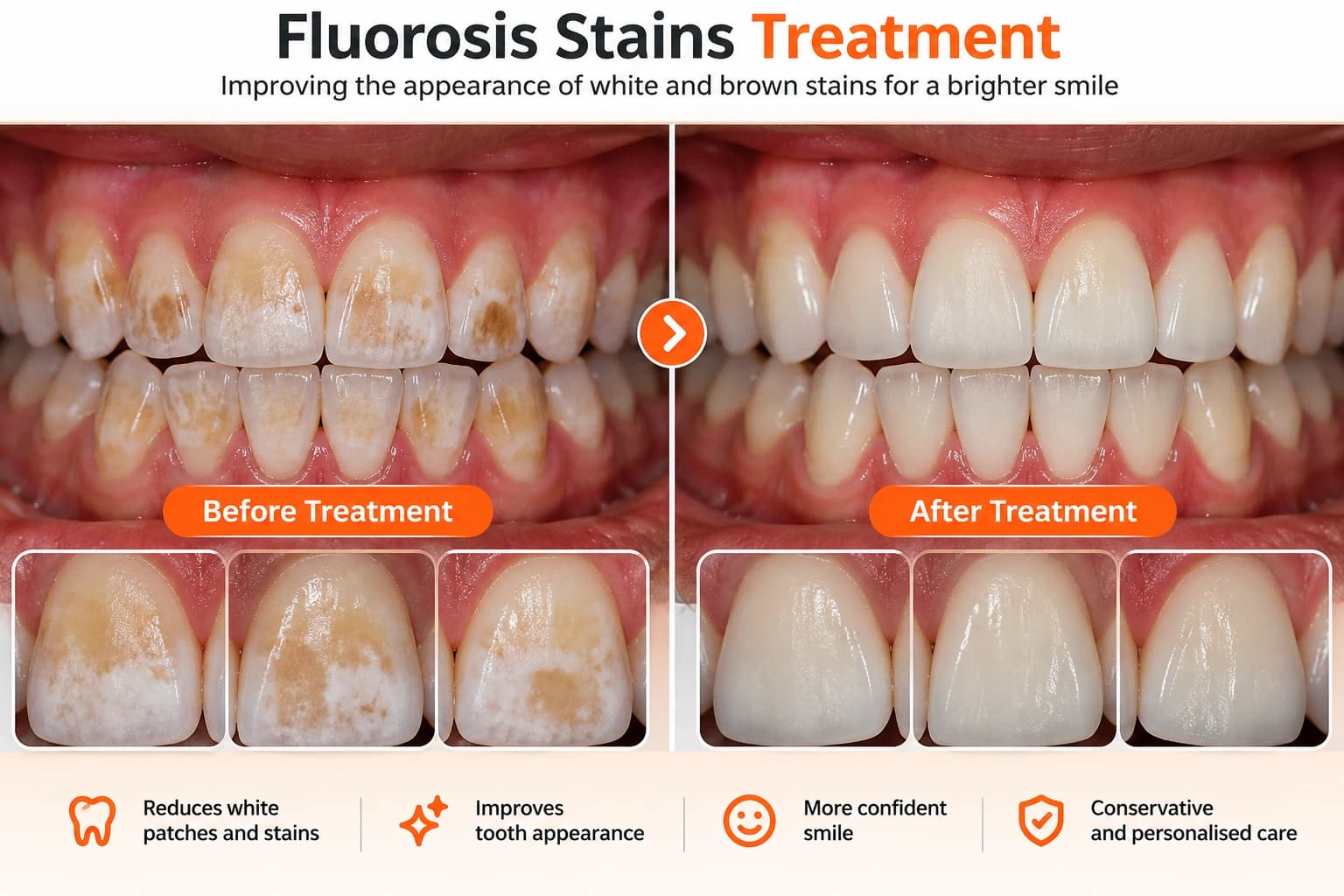
Cosmetic treatment may improve the appearance of selected fluorosis stains. Results vary depending on enamel condition and the treatment performed.
Cosmetic dental care
The right treatment depends on the depth of the marks, enamel condition, number of affected teeth and your smile goals. The most conservative suitable option is generally considered first.
OPTION 01
Selected cases where overall tooth shade is a concern
Professional whitening uses dental bleaching agents to lighten natural tooth colour. It may improve the overall shade in selected patients, but it does not remove the underlying enamel changes caused by fluorosis.
Important: White patches can remain visible or become more noticeable after whitening. A dentist should assess your teeth before recommending it.
OPTION 02
Selected superficial enamel discoloration
Microabrasion removes a very thin superficial layer of enamel using a controlled technique. It may improve certain superficial white or brown marks when the enamel condition is suitable.
Important: It is not appropriate for every stain, and unnecessary removal of enamel should be avoided.
OPTION 03
Selected white enamel opacity lesions
A specialised low-viscosity resin penetrates selected porous enamel lesions and can reduce the visual contrast between a white spot and the surrounding enamel.
Important: The result depends on lesion depth, appearance and case selection. It does not guarantee complete disappearance of every fluorosis mark.
OPTION 04
Selected visible defects requiring masking
Tooth-coloured composite material can cover or mask certain discoloured areas. It may be useful when a more targeted cosmetic correction is needed.
Important: Composite can stain, wear or chip over time and may need polishing, repair or replacement.
OPTION 05
Selected moderate or severe cosmetic concerns
Veneers are thin restorations bonded to the front surface of teeth. They may help improve colour, shape and appearance when more conservative treatments are unlikely to meet the patient's goals.
Important: Some tooth preparation may be necessary. Veneers require careful planning and long-term maintenance.
OPTION 06
Cases requiring an individualised approach
In selected cases, the dentist may consider a combination of conservative and restorative techniques to improve the appearance of fluorosis-affected teeth.
Important: The sequence and choice of treatment depend on the clinical findings, enamel condition and patient's expectations.
A treatment suitable for faint white marks may not be appropriate for deep brown discoloration or pitted enamel. The dentist will assess your teeth and discuss the advantages, limitations, possible sensitivity, maintenance requirements and expected cosmetic improvement before treatment.
Compare your options
This overview explains the general purpose of each approach. It is not a substitute for a clinical diagnosis or a personalised recommendation.
| Treatment | Main purpose | Important consideration |
|---|---|---|
| Whitening | Lighten overall natural tooth shade | White patches may remain more visible |
| Microabrasion | Improve selected superficial enamel marks | Removes a small amount of surface enamel |
| Resin infiltration | Reduce contrast in selected white spots | Not suitable for every lesion or stain |
| Composite bonding | Mask selected discoloured areas | May need maintenance or repair |
| Veneers | Improve colour and appearance of selected teeth | More involved and potentially irreversible |
Your visit
The aim of the initial consultation is to understand the cause of the discolouration and identify appropriate treatment choices.
Explain when you noticed the marks, what bothers you most and what you would like to improve.
The dentist assesses the distribution, colour, surface and severity of the enamel changes.
Discuss suitable conservative or restorative approaches, their limitations and expected results.
Agree on a treatment plan, estimated costs, appointments and maintenance needs before proceeding.
Protect your smile
Good oral hygiene and regular dental reviews help maintain oral health after cosmetic treatment. Specific instructions depend on the procedure performed.
Brush twice daily with fluoride toothpaste appropriate for your age and clean between your teeth regularly.
Follow the dentist's instructions about sensitivity, eating, drinking and oral care after your particular treatment.
Do not use charcoal powders, lemon juice, acids or aggressive scrubbing to try to remove enamel marks. These can damage teeth.
Review appointments help monitor sensitivity, gum health, restorations and the appearance of your teeth.
Local dental care
Dr. Bhuvan’s Dental Laser & Implant Centre is located in Ganapathi Complex, Navodaya Colony Road, Sri Krishna Nagar, Ameerpet, Yousufguda, Hyderabad, Telangana – 500073. Patients enquiring about dental fluorosis and cosmetic treatment can contact the clinic to discuss an appointment.
If you live in Ameerpet, Srinagar Colony, Yousufguda or Banjara Hills, you can enquire about available consultation timings and suitable treatment options.
Location: Ganapathi Complex, Navodaya Colony Road, Sri Krishna Nagar, Ameerpet, Yousufguda, Hyderabad, Telangana – 500073.
Phone: +91 80745 28763
Care: Dental assessment and cosmetic treatment enquiries
Good oral hygiene is important whether or not you choose cosmetic treatment. Learn more about professional teeth cleaning and maintaining healthy teeth and gums.
Learn About Teeth CleaningVisit Our Dental Clinic
Looking for fluorosis stains treatment near Ameerpet, Srinagar Colony, Yousufguda or Banjara Hills? Visit our dental clinic in Hyderabad for a consultation and personalised treatment planning.
Address:
Ganapathi Complex,
Navodaya Colony Road,
Sri Krishna Nagar,
Ameerpet, Yousufguda,
Hyderabad, Telangana – 500073.
Phone: +91 80745 28763
Patient information
Find answers to common questions about dental fluorosis, cosmetic treatment choices and aftercare.
Dental fluorosis is a change in enamel development caused by excessive fluoride exposure while teeth are forming. Depending on severity, it may appear as faint white lines, cloudy patches, mottled enamel, brown discoloration or surface pitting.
Fluorosis develops when too much fluoride is ingested during tooth development. The relevant exposure period is when the affected teeth are forming, rather than ordinary fluoride toothpaste use after the teeth have developed.
Some cases can be improved significantly, but complete removal cannot be guaranteed. The result depends on the depth and severity of the enamel changes and the treatment selected.
No. Whitening changes the shade of natural teeth but does not reverse fluorosis-related enamel changes. In some cases, white patches can become more noticeable after whitening.
There is no single best option for everyone. Resin infiltration, microabrasion, whitening or selected restorative treatments may be considered depending on the appearance, depth and diagnosis of the lesions.
Brown discoloration may be improved with selected cosmetic procedures, depending on its depth and cause. A dentist should first distinguish fluorosis from other causes of staining or enamel defects.
Many conservative cosmetic procedures involve little discomfort, although temporary sensitivity can occur. The experience depends on the procedure, enamel condition and individual sensitivity.
The number of appointments depends on the diagnosis and selected treatment. Some procedures may be completed in one visit, while other treatments require planning, multiple visits or follow-up appointments.
The cost depends on the number of affected teeth, severity, procedure selected and clinical requirements. A consultation is needed before an appropriate treatment plan and estimate can be provided.
The original developmental enamel changes do not simply recur in already formed teeth. However, new surface stains can develop, and cosmetic restorations may need maintenance or replacement over time.
No. Fluorosis is a developmental change in enamel. Tooth decay is caused by acids produced by bacteria acting on the teeth. However, other enamel defects and early decay can resemble white spots, so correct diagnosis matters.
Dr. Bhuvan’s Dental Laser & Implant Centre is located in the Ameerpet area of Hyderabad. Patients from nearby areas, including Srinagar Colony, Yousufguda and Banjara Hills, can contact the clinic to enquire about appointments.
Your smile, your plan
Begin with a dental assessment to understand the cause of your tooth discolouration and discuss the cosmetic options that may be appropriate for you.
Individual results vary. A clinical examination is required before treatment can be recommended.
Dr. Bhuvan’s Dental Laser & Implant Centre · Ameerpet, Hyderabad